Showing posts with label Red-breasted Flycatcher. Show all posts

Thursday, 1 June 2017

Estonia Part II - Haapsula, Matsula & the NW Coast 24th - 30th May

I drove more or less to Haapsula and slept overnight by the side of the road on the outskirts of town. That's the beauty of carrying your home with you, you can stop anywhere.
Johnnie (Mcloughlan) had given me some sites on the coast north of Haapsula so I decided to start with these the place is called Haversi but there are only one or two houses there and finding a road/track to the coast was not easy. Eventually I found the spot a spit sticking out a short way in to the sea. To get to it I travelled a long bumpy track which amazingly had a house which looked like it had come straight from Grand Designs at the end of it. 
House with a view and an amazing garden bird list I think

I came across a couple of male Red-backed Shrikes which was a good sign as I haven't seen many. Common Rosefinch and Thrush Nightingales were there as ever and I had several Marsh Warbler, one of which had a metal ring on and it would have been very interesting to know where that was from.
Red-backed Shrike - male

There were waders on the beach; 60+ Dunlin, all of the larger brightly coloured subspecies alpina. Apparently only schinzii breeds in Estonia so not surprisingly these are all migrants.
Dunlin of the alpina subspecies
There were also 8 Little Stint, which are scarce here, 2 summer plumaged Curlew Sandpiper, Temminck's Stint but best of all at least 4 Broad-billed Sandpiper.
Mixed flock of wader; Dunlin, Curlew Sandpiper, Ruff and Little Stint

Moving on I drove down the coast, past Pogeri-Sassi which added 4 Avocet to the list plus White-tailed Eagle and about 30 distant Dunlin. Carrying on down the coast to the migrant hot spot of Puise I could only find Wheatear and a few tardy Barnacle Geese. It was windy and still very sunny with temperatures around 26 centigrade.
I stayed at the camp site in Haapsula which was nice and had nest boxes occupied by Pied Flycatchers and several Northern Bullfinch in the area. I have noticed lots of nest boxes, not just in towns but in the isolated woodlands which is very encouraging.
The next day I drove down to Haeska on the north shore of Matsula bay. In the winter this area is thronging with geese and sea duck but it is quiet at the end of May. Another visit to Puise produced a couple of singing and flight displaying Barred Warbler.
Barred Warbler in display flight

I decided to try the Sutlepa Meri area just north of Haapsula, all these sites have bird watching towers but whilst they give a good panorama of the area the birds are much to far away to photograph. There were Little Gulls, White-tailed Eagle and Bitterns booming. Closer in Penduline Tits were calling and feeding. 
Leaving Haapsula I moved up the coast to a lovely woodland camp site almost on the beach. It's just north of Haversi so I had another look at the ponds and was delighted to see at least 23 Broad-billed Sandpiper and this time managed some decent photos. As I walked down the track I could hear a Black Grouse giving its display calls and eventually found the male but too hidden to photograph.
Broad-billed Sandpiper

Just north of Roosta I met another birder watcher, Jan Nordblad a Finn but a great enthusiast for birding in Estonia and currently heading the list of birds seen in Estonia on the Birding Estonia web site. We spent the next couple of days birding together which allowed me to get a better idea of the status of birds in Estonia and the Estonia birding scene in general so thank you Jan!
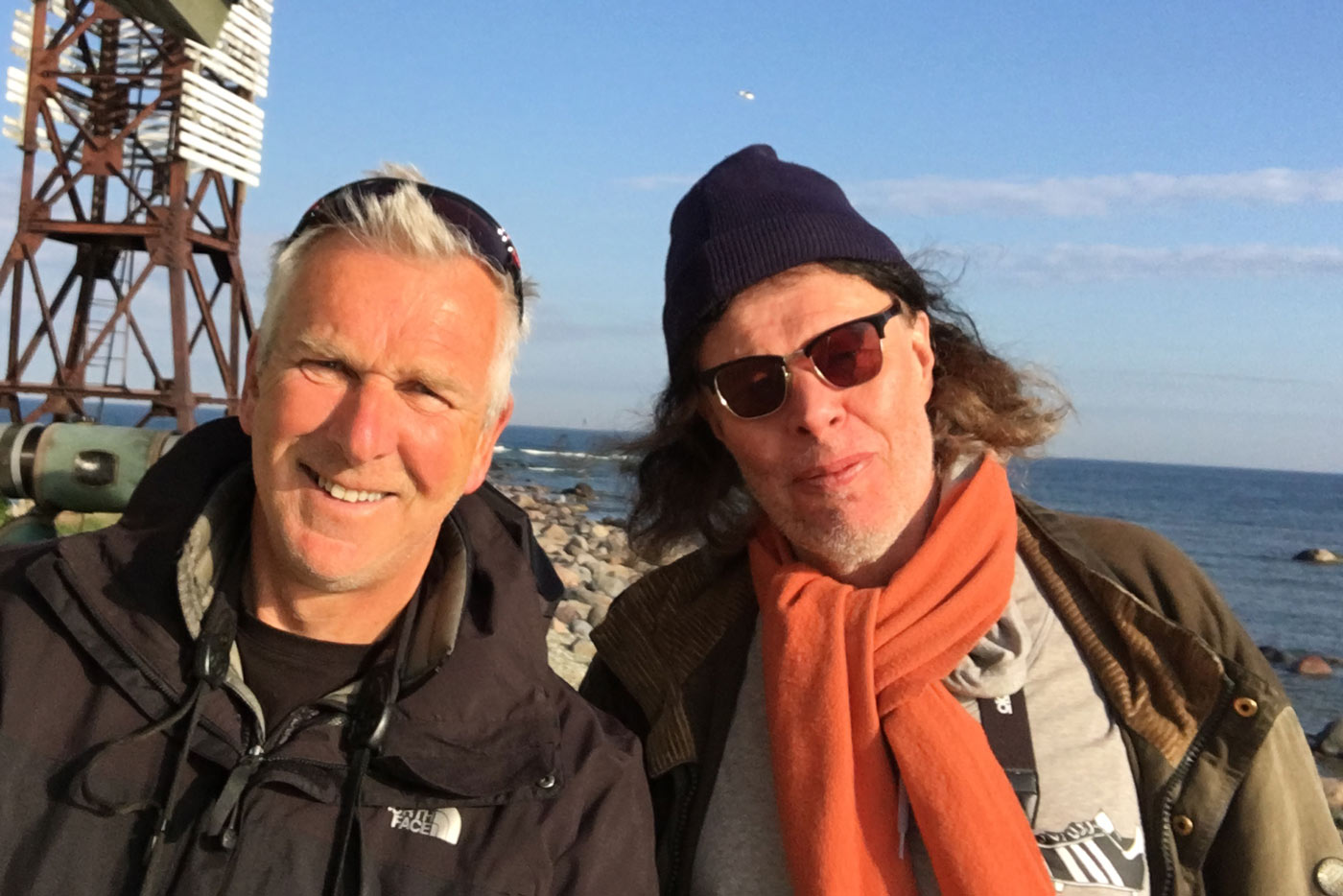
Jan and I at Spithami

I tried several times for Hazel Hen at a site which Jan kept reminding me was virtually guaranteed for them, but as many of you will know there are few absolute certainties in the birding world.
The following morning we met, after I checked for Hazel Hen, at Spithami at 05:00 (it gets light about 04:00 and dark at 22:00 so they are already long days. Spithami is famous for the migration of Black-throated Divers heading back to their breeding grounds and counts of over a thousand birds in a day are quite common in the Spring. We managed about 70 which is still the most I have seen in a day. Both Red-breasted Merganser and Gooseander were moving up and down the coast with groups of Goldeneye and Common Scoter and parties of Long-taile duck on the sea. We had Crossbills and Hobby and 2 Osprey but it was a quiet day for migration. There is a fantastic cafe at nearby Dirhami which is also good for migrants so we had a break there before resuming our search. The woods there had Red-breasted Flycatchers but couldn't find anything scarce although Jan regaled me with tales of Booted Warblers and other rarities form the coastal islands which he had seen so my enthusiasm never waned.
Red-breasted Flycatcher - singing male, less than 20% have red-breasts

The following morning was similar and the hoped for big diver migration never occurred whist I was there. In the afternoon I drove to the open agricultural fields at Variku which often hold raptors and I did mange a distant harrier but little else.
My final morning in the area we decided to check to Haversi pools for a last time and I was amazed to see that most of the Dunlin had departed but the number of Broad-billed Sandpiper had increased to at least 60 (more likely 70 but I need to check my photos), this is an incredible flock and I can't think of any where else in Europe that gets such a number.

Broad-billed Sandpipers in flight

On that high note I bid Jan farewell and headed for Tallinn for the ferry to Helsinki the following morning. I stopped on the harbour campsite and noted that even here almost in the heart of Tallinn both Common Rosefinch and Thrush Nightingale were singing. So tomorrow I will be entering the Finland stage of my journey.

Tuesday, 9 May 2017

Bialowieza, Poland 6th -10th May

We arrived at the U Michala campsite on the outskirts of Bialowieza late afternoon on Saturday, the temperature was a very pleasant 26°C and we enjoyed our evening meal in the open air to the sound of Wrynecks calling.
Dinner at U Michala Campsite

That night it started raining and, on and off, it continued most of the following day. The mid day temperature fell to around 11°C but although in remained overcast the next couple of days were mainly dry. Today Tuesday 9th May it has turned cold with an early morning temperature of 3°C and a bitter wind with frequent snow showers but with blue skies between. It appears that the weather in Poland is as variable as the UK!
Bialowieza is famous, amongst other things for the number of species of woodpecker in its woodlands and on our first day I managed White-backed in addition to the much commoner Great Spotted Woodpecker. 
White-backed Woodpecker
Over the next couple of days I added several Middle Spotted and Black Woodpeckers but despite extensive searches couldn't find Three-toed. Hopefully I'll find this northern species elsewhere on the trip.
Middle Spotted Woodpecker

The Palace Park in the centre of the village is one of the premier birding spots. This building in the park is one of the oldest buildings in the area, constructed in 1845. 
The old lodge, Palace Park
During my first visit to the park I had found a very obliging Collared Flycatcher at a nest site. I thought the female might already be incubating but the following day I saw both birds carrying nesting material in to the hole. 
Collared Flycatcher - male

Collared Flycatcher - female
Another Flycatcher which breeds no further West in Europe than Poland is the Red-breasted Flycatcher and I managed a single male singing from high in the tree canopy.
Red-breasted Flycatcher - male

A single Common Rosefinch was giving its simple whistle from on of the islands on the lake but this is the only bird I encountered during our stay so I must be slightly ahead of their arrival date. Another bird which attracts birders to Eastern Poland is the Thrush Nightingale which replaces the Nightingale of Central and Southern Europe here. I only came across half a dozen different birds so the main contingent must also still be on their way. Like the Nightingale the Thrush Nightingale is not easy to photograph singing its powerful song from deep within a bush but after several attempts I finally found a more cooperative bird. 

Thrush Nightingale
Birds of prey have been few and far between but on our first day a Lesser Spotted Eagle flew overhead carrying an item of prey, presumably to a nearby nest although we never saw the bird again.
Lesser Spotted Eagle -showing the upper wing


Visiting Eastern and Northern Europe one of the birds I was hoping to see was the Long-tailed Tit, here the species has an all white head making it look quite different from the subspecies we see at home. I have only seen one once before, at Easington in 2005 so was pleased to find a couple of birds today that allowed me to capture some photos.
Northern Long-tailed Tit

Apart from a glimpse of Roe Deer in the forest the only mammal we have seen is the Red Squirrel, and this individual posed well whilst eating a Larch cone.
Red Squirrel

In spite of all the birds and other wildlife, the most famous wild inhabitant of the area around Bialowieza is the European Bison. Extinct in the wild in 1919 when the last wild animal was poached the animal was reintroduced in 1952 from zoo stock and the wild population now numbers over 1000 animals in eastern Poland and neighbouring Belarus. We saw captive animals when we visited the Bison enclosure whilst looking for Red-breasted Flycatcher but so far I haven't managed to see the wild animals but will have another look early tomorrow morning before we move north to Biebrza.
Captive European Bison


Wednesday, 4 May 2016

The Black Sea Coast

It was pouring with rain when I woke on 2nd May. I wondered around the deserted holiday village of Kamchia, these are strange places when they are empty. It's hard to imagine it every being busy and many of the buildings looked derelict. Needless to say I didn't see anything in the rain and wind so I moved north to Cape Kaliakra. The rain had just about stopped but the wind was still blowing when I arrived. As soon as I got out of the car I had hear the tuck call of Sylvia warblers and the 'hooeet' of a Willow Warbler. There were other calls too which I didn't recognise, this looked promising. A male Golden Oriole flew past and I could hear Bee-eaters calling. I stopped out of the wind and soon had brief views of a female Red-breasted Flycatcher, they gave a rippling ticking call like a subdued Wren and a more plaintive 'seep', the calls were coming from several directions at the same time and I put 6 in my note book but there could have been a dozen. 
Red-breasted Flycatcher - female, great little birds
Whilst I was watching one bird 2 Red-backed Shrikes appeared on the edge of a nearby bush.
I moved on slowly to the old walls which are a well known site for Pied Wheatear, one of the few places where this bird can be reliably seen in Europe. Sure enough within a few minutes a male appeared and what a superb bird it was. I've seen immature birds as vagrants in the UK but this was my first adult male. 
Pied Wheatear - males upper two photos and female below
Also on the wall was a male Black-headed Bunting which appeared exhausted as it allowed a very close approach. A female Pied Wheatear joined the male and as I searched round the area and the walk down to the Cafe I must have seen 7 or 8 birds plus 2 Northern Wheatear. 
Black-headed Bunting - male
As I walked down the narrow road a Little Bittern flew up from under my feet, the wind quickly took it away and it was lost from view.
Over the sea I saw several distance groups of small shearwaters which I presumed were Yelkouan but were too distant to tell
After several hours I got back in the van for the drive up the coast to Shabla, just as I was leaving Kaliakra a Great Spotted Cuckoo flew up from the road and landed in a roadside tree, this is well north of their normal range which ends at the southern Black Sea, an unusual record.
I parked near the campsite at Shabla Lake and saw someone bird watching down the track. I caught them up and was surprised to see that it was John Grist, someone I bird watched with in my twenties at Fairburn Ings and who I usually see at Spurn, it's a small world! He was coming to the end of a two week stay at Shabla. As we were talking a Ruddy Shellduck appeared on the lake along with several Ferruginous Ducks.  They had seen the first Thrush Nightingales and Paddyfield Warblers in the last few days and a Great Snipe just a little up the coast at Durankulak. Unfortunately it was raining again but I decided to have a look for the snipe, I saw several Roller on roadside wires as I drove a little further north, surprisingly these were my first of the trip.
No sign of the Great Snipe but there were hundreds of Black Terns feeding close inshore due to the wind, also quite a few White-winged Black Terns and Little Gulls with them, a fantastic sight. It was late in the evening but hopefully the photo gives an indication of the scene.

Black Terns
Unfortunately I had bad news from home that evening; Pam's mum had been unwell when we left in March but she had deteriorated whilst we were at Kerkini and was admitted to hospital. Her condition was getting worse and I decided that I was needed at home so would have to postpone the rest of my trip for another year. I will go home via Hungary and will make a few stops on the way.