Showing posts with label Red-backed Shrike. Show all posts

Wednesday, 26 June 2019

Croatia 28th May - 9th June

We crossed the impressive toll bridge on to the island of Krk on the afternoon of 28th June and drove down to Krk town where we booked accommodation at Ana Rooms via Booking.com for 65€ (~£58) for 2 nights. The property was within easy walking distance of the centre and close to open countryside in a modern elegant property. I took a walk along a track into a maze of walled olive groves. A Cirl Bunting was singing from the top of a bush and I soon heard several Eastern Subalpine Warblers. I returned to the same area the following morning with a light rain still falling and added Red-backed Shrike plus a distant Lesser Grey Shrike. The latter was rather frustrating as it was sat in the open on top of a bush but the maze of deep drystone walls made it impossible to get closer. Sardinian Warblers were also present with the Eastern Subalpines. 
Cirl Bunting - male in song

The following morning I returned to the Krk Airport area where I had searched in vane for Rock Partridge in 2016.
Krk dry stone walls- the ground was covered in rocks and I concluded they just piled them up to clear the ground?
The signs were not good with heavy rain showers and almost gale force wind. Pam and I trudged up and down the area east of the quarry but it felt hopeless. We disturbed at least 6 Red-backed Shrikes which were sheltering close to the ground out of the wind but couldn't find the partridge. A single Eastern Black-eared Wheatear flew towards the quarry but in the weather conditions there seemed little point in pursuing it so we left the area heading south again hoping for more luck on the island of Pag.

We decided to stay at Nin for four nights at Apartments Ventura which were opposite the small island town of Nin and 
right on the coast. The weather finally started to improve and we enjoyed glorious sunshine here.
On Nin itself there was a large colony of Spanish Sparrow by the church and a pair of Woodchat Shrike.
Woodchat Shrike - female

Nin was badly flooded in 2017 and they were still repairing some of the access roads including that which ran parallel to the salt pans which made access to that area difficult although other than Little Terns and Black-winged Stilts there did not appear to be much bird activity.
Aerial view of the 2017 flooding at Nin on a poster at the town entrance

As we drove in to Nin Pam saw a Pygmy Cormorant sat on a rock close to the old town and subsequently we saw 2 or 3 everyday sat on posts or this same rock.
Pygmy Cormorant

A short walk from the apartment was some open ground with scattered trees, Turtle Doves and Nightingales could be heard with the occasional flutey whistle from Golden Oriole. Several pairs of Red-backed Shrike were courting and I came across a pair of Eastern Subalpine Warblers feeding young in a nest. The female was very elusive but the male came along the tops of the bushes to the nest giving some excellent views. He brought a range of different sizes of spiders, small butterflies and quite a large grasshopper of some kind.
Eastern Subalpine Warbler - male with a cricket
Eastern Subalpine Warbler - male

The male Red-backed Shrikes were very vocal giving a short croaking call that I can't recall hearing before and were clearly in courting mode as they were regularly chasing the females.
Red-backed Shrikes - male and female
From Nin we drove down the coast through Zadar to Lake Vrana. There is a conservation area on its northern edge with a decent boardwalk which gave good views of the lake and the reed bed. Pygmy Cormorants were flying past in ones and twos and there were marsh terns feeding over the lake including both White-winged and Whiskered Terns but they were always distant. Purple Herons kept appearing over the reed beds then disappearing in to them again. From the reeds Great Reed Warblers were calling incessantly with the occasional Cetti's Warbler. A couple of male Montagu's Harriers drifted northwards high over the lake and we also saw singles closer to Nin.
Montagu's Harrier - male

The following morning I got up early and drove round to the island of Pag. There are two linked wetlands on what is otherwise a very barren island so I headed for Veliko Blato which has open water and reed beds.
Sign at Veliko Blato

The edge of the lake is easily accessible and this held several Squacco Herons feeding amongst the sheep. 
Squacco Heron

There were also Crested Larks here and a few waders with singles of Wood Sandpiper and Little-ringed Plover I also saw several Lapwing in a wet area by the main road as I turned off to Veliko Blato. The only raptor was a rather tatty female Marsh Harrier and it was clear that I was at the tail end of migration here although small parties of Bee-eater were still moving. I stopped at various spots for Rock Partridge but without success.
The following morning I had another look around Nin, close to the salt pans I came across a hippolais warbler in song. It was sat out in the open but frustratingly, due to dense vegetation, I couldn't get very close. The song lacked the wheezy nasal elements of Icterine, not sure why its named Melodious though as it was still fast and scratchy. The primary projection was short, pale wing panel very narrow and buffy yellow underparts with yellow restricted to throat so all good for Melodious.
Melodious Warbler
Later that day we drove to Starigrad with a view to driving up to Veliko Rujno but the narrow road had suffered a landslip in the village and was impassable. I tried to find an alternate road to link up above the landslip but nothing connected so we entered the main Paklenica Park entrance. There were many climbers and few birds. Having walked fairly well up the gorge I tried in the low wooded area near the park entrance and soon found a singing Icterine Warbler. Croatia is one of the few countries where their breeding ranges overlap and seeing both species the same day was a real treat. The Icterine had a striking wing panel (although I've recently seen photos of Melodious with a distinct wing panel in the Netherlands so this is not a diagnostic feature). Primary projection was very long, equal to the exposed tertials and the underparts were a more uniform yellow and it looks like a short 1st primary is just visible. The song contained the characteristic repeated wheezy nasal elements.
Icterine Warbler
After leaving the park I had another look for a road up to Veliko Rujno and finally found an alternate route. Stops on the way up produced more Eastern Subalpine and where the paved road ends I had rather poor views of two Eastern Orphean Warblers, calling tack tack which to my ears was the same as Blackcap but no song.

We had a last day at Nin on 2nd June and made another trip to Pag. At a small supermarket at the entrance to Povljana there were both House and Spanish Sparrows together and I saw mating House and mating Spanish but no interspecies mating and no sign of any hybrid birds.
House and Spanish Sparrows
Spanish Sparrows courting with House Sparrow looking on, note the blackish throat on this female

I Left Pam by the beach at Povljana and drove over to Veliko Malo, just as I left the shoreline a Rock Partridge flew over the road in front of me and appeared to land in a rocky field.
I parked up and scanned the field, no sign. I waited and after several minutes it appeared below a bush, stood still for 30 seconds then moved out of view.
Rock Partridge

I waited another 15 minutes with no further sign then I heard a second bird calling some distance away and picked it up on top of a wall. It was distant but stood out in the open, Rock Partridge at last.
Rock Partridge

Whilst they may not be guaranteed on Pag or Krk the chances of seeing them and getting decent views appear a lot higher than on the hills of Paklenica or for that matter the French or Swiss Alps.
Rock Partridge habitat on Pag
The following day we moved to Camp Igor on the coastal southern edge of Starigrad. Early the next morning I walked up a paved road just south of the campsite and almost immediately heard the flutey song of Eastern Orphean Warbler, then another and within half an hour I counted at least six singing males. They appeared to choose the tops of the tallest trees as song post but after an hour or so I managed some reasonable photos.

Eastern Orphean Warbler - males
All the males I saw had irises that were only a slightly lighter blue grey than the pupil. The dark blotches on the under tail coverts are just visible on the lower bird as well as the extensive bluish bill base which help to distinguish Eastern from Western Orphean.
From Starigrad we started to head back north stopping at a large but empty campsite by the pretty fishing village of Klenovica and then continuing on to Pula in Istria where we stayed in Apartment T&S off Booking.com €124 (~£111) for 4 nights. A couple of km from Pula centre but walkable.
Pula amphitheatre
The amphitheatre at Pula is certainly spectacular and its a decent town centre. Nearby a promontory sticks out in to the Adriatic which forms the southern tip of Istria and is a protected area called Kamenjak. At times in the spring it must be alive with birds but Pam and I had the usual Eastern Subalpine Warblers, Red-backed Shrikes plus Woodlark and Tawny Pipit with lots of Shag off shore and a couple of orchids but apparently there are 30 species to be found here.
Tawny Pipit
 About 30km to the north of Pula there is another reserve, a coastal swamp called Palud. There were very few birds and lots of mosquitos when we visited but I could imagine it pulling birds in when the weather is right.
Palud reserve from the small hide

We saw Shelducks, Eastern Subalpine Warblers this time feeding fledged young and a few Little Egrets.

After Pula we headed north back in to Slovenia but we stopped a couple of times on the way to look at wooded and scrub areas. One bird I hadn't seen this trip was Sombre Tit although we'd looked in many areas that looked suitable but had no luck, are there Sombre Tit in Istria? Stopping near Pazin we came across a lovely group of flowering Lizard Orchids before finally leaving Croatia.
Lizard Orchid

Thursday, 1 June 2017

Estonia Part II - Haapsula, Matsula & the NW Coast 24th - 30th May

I drove more or less to Haapsula and slept overnight by the side of the road on the outskirts of town. That's the beauty of carrying your home with you, you can stop anywhere.
Johnnie (Mcloughlan) had given me some sites on the coast north of Haapsula so I decided to start with these the place is called Haversi but there are only one or two houses there and finding a road/track to the coast was not easy. Eventually I found the spot a spit sticking out a short way in to the sea. To get to it I travelled a long bumpy track which amazingly had a house which looked like it had come straight from Grand Designs at the end of it. 
House with a view and an amazing garden bird list I think

I came across a couple of male Red-backed Shrikes which was a good sign as I haven't seen many. Common Rosefinch and Thrush Nightingales were there as ever and I had several Marsh Warbler, one of which had a metal ring on and it would have been very interesting to know where that was from.
Red-backed Shrike - male

There were waders on the beach; 60+ Dunlin, all of the larger brightly coloured subspecies alpina. Apparently only schinzii breeds in Estonia so not surprisingly these are all migrants.
Dunlin of the alpina subspecies
There were also 8 Little Stint, which are scarce here, 2 summer plumaged Curlew Sandpiper, Temminck's Stint but best of all at least 4 Broad-billed Sandpiper.
Mixed flock of wader; Dunlin, Curlew Sandpiper, Ruff and Little Stint

Moving on I drove down the coast, past Pogeri-Sassi which added 4 Avocet to the list plus White-tailed Eagle and about 30 distant Dunlin. Carrying on down the coast to the migrant hot spot of Puise I could only find Wheatear and a few tardy Barnacle Geese. It was windy and still very sunny with temperatures around 26 centigrade.
I stayed at the camp site in Haapsula which was nice and had nest boxes occupied by Pied Flycatchers and several Northern Bullfinch in the area. I have noticed lots of nest boxes, not just in towns but in the isolated woodlands which is very encouraging.
The next day I drove down to Haeska on the north shore of Matsula bay. In the winter this area is thronging with geese and sea duck but it is quiet at the end of May. Another visit to Puise produced a couple of singing and flight displaying Barred Warbler.
Barred Warbler in display flight

I decided to try the Sutlepa Meri area just north of Haapsula, all these sites have bird watching towers but whilst they give a good panorama of the area the birds are much to far away to photograph. There were Little Gulls, White-tailed Eagle and Bitterns booming. Closer in Penduline Tits were calling and feeding. 
Leaving Haapsula I moved up the coast to a lovely woodland camp site almost on the beach. It's just north of Haversi so I had another look at the ponds and was delighted to see at least 23 Broad-billed Sandpiper and this time managed some decent photos. As I walked down the track I could hear a Black Grouse giving its display calls and eventually found the male but too hidden to photograph.
Broad-billed Sandpiper

Just north of Roosta I met another birder watcher, Jan Nordblad a Finn but a great enthusiast for birding in Estonia and currently heading the list of birds seen in Estonia on the Birding Estonia web site. We spent the next couple of days birding together which allowed me to get a better idea of the status of birds in Estonia and the Estonia birding scene in general so thank you Jan!
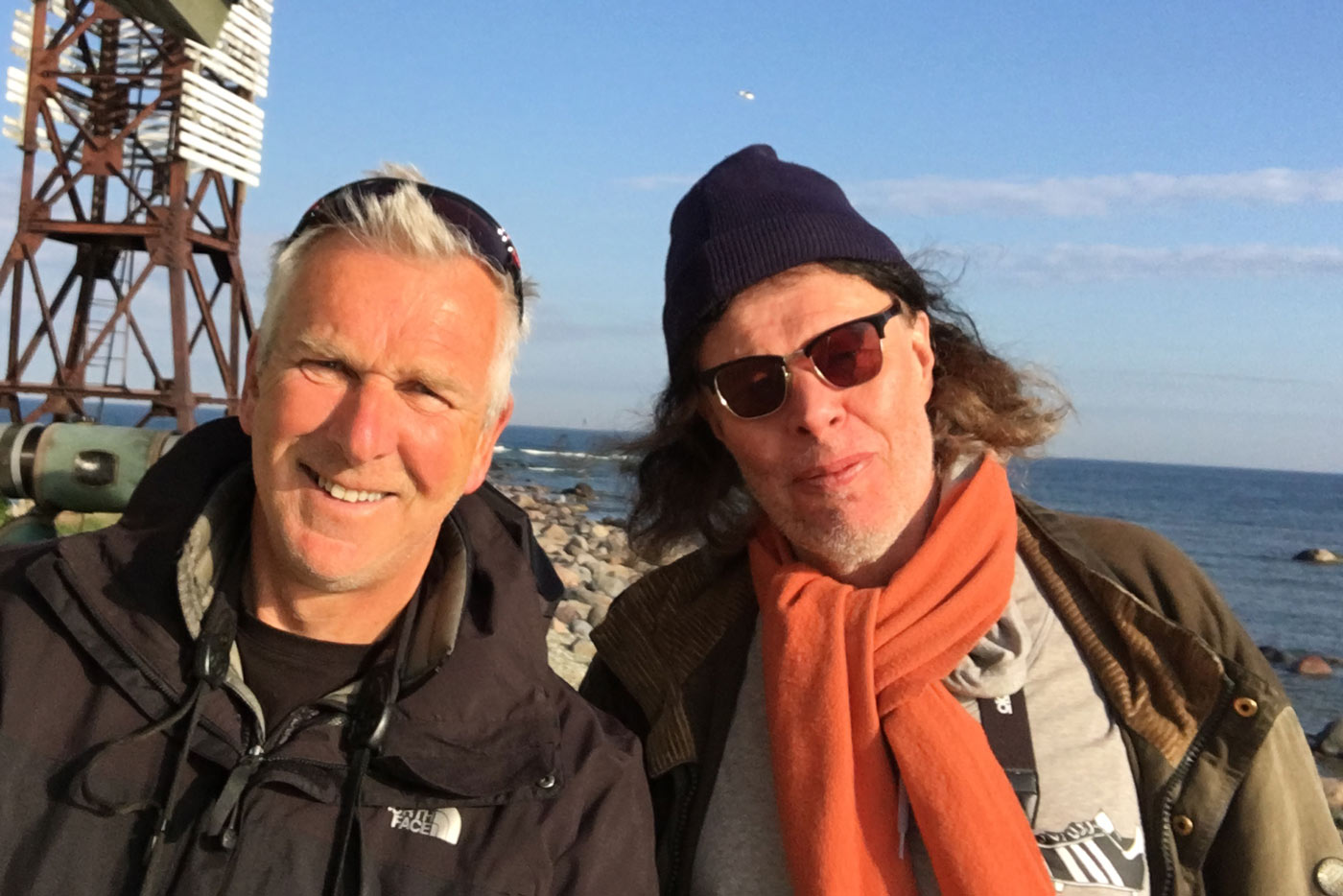
Jan and I at Spithami

I tried several times for Hazel Hen at a site which Jan kept reminding me was virtually guaranteed for them, but as many of you will know there are few absolute certainties in the birding world.
The following morning we met, after I checked for Hazel Hen, at Spithami at 05:00 (it gets light about 04:00 and dark at 22:00 so they are already long days. Spithami is famous for the migration of Black-throated Divers heading back to their breeding grounds and counts of over a thousand birds in a day are quite common in the Spring. We managed about 70 which is still the most I have seen in a day. Both Red-breasted Merganser and Gooseander were moving up and down the coast with groups of Goldeneye and Common Scoter and parties of Long-taile duck on the sea. We had Crossbills and Hobby and 2 Osprey but it was a quiet day for migration. There is a fantastic cafe at nearby Dirhami which is also good for migrants so we had a break there before resuming our search. The woods there had Red-breasted Flycatchers but couldn't find anything scarce although Jan regaled me with tales of Booted Warblers and other rarities form the coastal islands which he had seen so my enthusiasm never waned.
Red-breasted Flycatcher - singing male, less than 20% have red-breasts

The following morning was similar and the hoped for big diver migration never occurred whist I was there. In the afternoon I drove to the open agricultural fields at Variku which often hold raptors and I did mange a distant harrier but little else.
My final morning in the area we decided to check to Haversi pools for a last time and I was amazed to see that most of the Dunlin had departed but the number of Broad-billed Sandpiper had increased to at least 60 (more likely 70 but I need to check my photos), this is an incredible flock and I can't think of any where else in Europe that gets such a number.

Broad-billed Sandpipers in flight

On that high note I bid Jan farewell and headed for Tallinn for the ferry to Helsinki the following morning. I stopped on the harbour campsite and noted that even here almost in the heart of Tallinn both Common Rosefinch and Thrush Nightingale were singing. So tomorrow I will be entering the Finland stage of my journey.

Saturday, 13 May 2017

Biebrza Marshes, Poland 10th to 12th May

On our final morning I did another early check for Bison but again without success, I drove up to the rather remote forest glades of Kosy Most and saw two female Elk cross the road but they were gone in a few strides of their long legs. At Kosy Most I had at least three singing male Barred Warblers which are new for the trip and the first I have seen in their barred breeding plumage.
Barred Warbler

I also got some nice views of Wryneck which, although present around the campsite, I hadn't managed to photograph. Their insistent pee-pee-pee call is a feature of the parks and gardens in this area.
Singing Wryneck
Driving north from Bialowieza we headed for Siemienowka Reservoir. 
Siemienowka Reservoir - in the distance! With a foreboding sky
It looks to be a similar size to my local Carsington Water and like there many of the birds, which included White-winged Black and Whiskered Terns were very distant. As we started to explore the pools at the NE corner three White-tailed Eagles circled, sparring with each other. What an amazing site to see these huge eagles reasonably close.
White-tailed Eagles - immature with colour rings
There were Great Reed Warblers singing in the reeds and giving excellent views and we also recorded our first Red-backed Shrike of the trip, a lovely female.
Great Reed Warbler
Red-backed Shrike -female
No sight our sound of Citrine Wagtails which breed in this area but we left happy with the eagles.
We continued north to the campsite close to the Biebrza National Park offices at Osowiec. We were the only campers at the site which is right by the river and within easy walking distance of pools at Osowiec-Twierdza. I should comment at this point that Pam and I speak no Polish and can just about manage please and thank you but the pronunciation of most of the place names was well beyond us.
On the camp site we had Thrush Nightingales and a calling Lesser Spotted Woodpecker which was nice to see. I also found a Hawfinch next to where we were camped but the female was sitting and the male only seemed to make occasional visits so I missed this photo opportunity. Over the pools we had two Hobby hawking for dragonflies in the evening and there were dozens of Wood Sandpiper feeding on floating vegetation alongside the more familiar Common Sandpiper.
Lesser Spotted Woodpecker
The following morning I walked round the Osowiec pools and added the first Bluethroat of the trip, a strikingly coloured male.
Osowiec marshes

The reeds also held singing Savi's Warbler and Penduline Tit whilst high overhead groups of White-winged Black and Whiskered Terns flew up river calling with several parties of Ruff.
Bluethroat - male
Later that morning we headed off for the Czar's Road which tracks the eastern edge of southern basin of Biebrza Marshes. We had only travelled a short distance when a bird of prey flew up from the roadside and landed in the trees close by us. Lesser Spotted Eagle, my closest views of this superb bird which stayed in the trees for 5 minutes thankfully allowing me time to get my camera and capture some images.
Lesser Spotted Eagle - adult I think
I got a little confused with the tracks and we ended up walking the 4km Honczarowska Dyke, which wasn't wasted as we saw what is perhaps the most famous bird of the marshes the sadly declining Aquatic Warbler. The views were distant but I was pleased to see it in one of its last areas with a decent population. There are signs all round the park detailing the work that is being done to conserve this species.
A little later we visited the Dluga Luka boardwalk which gives better access to the reedy grassland which the favour but all we could see were their close relative the Sedge Warbler. 
Dluga Luka boardwalk - it was all hands on deck looking for Aquatic Warbler
We returned early the following morning and saw another bird but in the rather windy conditions it was impossible to see singing birds. Whilst we waited a male Montagu's Harrier crossed the marsh.
Further south on the Czar's Road we stopped at the pools bordering the minor road to Zajki which had hundreds of White-winged Black Terns feeding over them. Periodically the whole flock would rise in the area calling loudly before returning to feed again.
White-winged Black Terns - arguing
We set off north again after a brief visit to the Wizna marshes, hoping for lekking Ruff but all the Ruff, which numbered many hundreds were feeding out on the flooded river. I did get nice photos of a male Yellow Wagtail which looked like Ashy-headed with a pale supercilium so not entirely sure what race it was but quite a striking bird. Driving up the western edge of the southern basin we stopped at Mscichy and saw more Sedge Warblers and several Black-tailed Godwits.
Yellow Wagtail 
We left Mscichy on Friday afternoon and continued north in to Lithuania which is a new country for both of us.


Wednesday, 27 April 2016

Lake Kerkini - Part 2

The weather changed on the 22nd April, after 5 days of clear blue skies it became overcast and we had some heavy rain overnight.
Returning from the airport with Pam we stopped at Mandraki Harbour where a party of 52 Glossy Ibis were busy washing, preening and wing flapping which indicates that they are probably recently arrived migrants.
Glossy Ibis
On the 23rd we took a boat trip out on to the lake which provided great views of the pelicans, although to avoid disturbing the breeding birds the boats keep a sensible distance away from the nesting areas. The water has been rising steadily for the past 3 or 4 days. This is controlled rise to fill the lake in order to provide water for crop irrigation through the summer but it does enable better boat access in to some of the areas where the cormorants, egrets, and herons sit during the day. 
Pelicans - White in the foreground and Dalmatian at the rear
Whilst on the boat we had a party of a dozen Whiskered Terns, which are my first for the area.
It rained again in the night and the following morning I did an early morning walk around where we are staying at Korifoudi. It was immediately apparent that there were new birds around, the number of Golden Oriole calling had risen dramatically, I estimated at least 20 in the immediate area. 
Golden Oriole - male
Birds noted on the walk were as follows;
Red-backed Shrike 4 males - new for the trip
Masked Shrike 1 male
Lesser Grey Shrike 2 - had my first of the trip yesterday
Lesser Whitethroat 1
Golden Oriole 20
Eastern Olivaceous Warbler 6
Turtle Dove 22
Black-headed Wagtail 2
Nightingale 15+ these have been around for some time.
Black Stork 1 giving superb views
Lesser Grey Shrike
Eastern Olivaceous Warbler
Red-backed Shrike - male
Black Stork
Not bad for a couple of hours walking around Korifoudi!
Driving around the lake we had several more Red-backed Shrikes and good numbers of Bee-eaters along with the usual pelicans, cormorants and herons.
I had hoped that by spending some time at Kerkini I would witness the arrival of migrants from the south and I had experienced just that.
I'll be exploring some of the other birding sites on the coast around Thessalonika over the next few days to see what they have to offer.