Showing posts with label Velvet Scoter. Show all posts

Tuesday, 9 October 2018

Shetland Road Trip 25th Sept - 3rd Oct

Despite having spent more than 4 decades birdwatching in the UK I have never been to the Shetland Isles. So when Roger Barnes, a birding friend from Leeds, suggested a trip in late September I jumped at the chance. Roger already had a reservation on Fair Isle for 1st to 5th October where he was due to meet some friends so the timing of the visit was set around these dates.
There are a variety of ways to travel to Shetland and in the end we decided to drive in the camper and catch the ferry from Aberdeen to Lerwick. This gave us flexibility on the journey up and for our time on Shetland. We set off on 25th September with our first planned stop at Barns Ness, just over the Scottish border, where a 1st winter Woodchat Shrike had been showing well for several days.
Roger and I arriving at the aptly named Barns Ness

We arrived at Barns Ness in strong winds and overcast skies but there were a couple of other bird watchers in view and it turned out that they were watching the shrike and so were we within a few minutes of our arrival.
Woodchat Shrike 1st winter

A first winter Rose-coloured Starling had also been reported a few days earlier and in speaking to the locals we soon established that it was still present, feeding on the beach with Common Starlings. In the strong winds Starlings were flying in all directions but we persisted and eventually located the bird with about 30 Common Starling on the beach. Unfortunately the birds were flushed by another birder so we only managed rather distant views. 
Rose-coloured Starling with Common Starlings
The weather was forecast to improve later in the afternoon so we were keen to get to Musselburgh, our next stop.


Roger and I spent a week in Iceland in 2016 where we failed to find a regular summering White-winged Scoter so the opportunity to see a male that had been found in Spring this year was too good to miss.
Velvet Scoter - males
From the sea wall there were several groups of Velvet Scoter plus ones and two's spread over a kilometre or so. It looked like it might be a long task to search through them all but luck was with us again when we came across some local birders who had located the White-winged Scoter.

Once found, the pink rather than yellow, bill along with the swollen bill shape at the nostrils and large white tick behind the eye made it relatively easy to pick up, at least in good light.
White-winged and Velvet Scoter
White-winged Scoter
An adult Red-throated Diver moulting from summer plumage was feeding close to the seawall and provided a good photo opportunity.
Red-throated Diver - adult moulting from summer plumage

A Pectoral Sandpiper was also present on the nearby lagoons and we managed to locate this bird before dark and again the following morning where there were also two juvenile Curlew Sandpipers but all were distant telescope views.
From Musselburgh it was none stop to Aberdeen for our 7pm ferry to Lerwick. The wind was still blowing so the prospect of 12 hours on a rough sea was a little daunting but in the end the crossing was OK and we arrived on time in Lerwick.
Fulmar

The wind was still blowing westerly and there were few birds reported on Shetland so we did an initial tour of the southern part of Mainland calling at Sumburgh where we watched the Fulmars still occupying their nesting cliffs, Scatness where a Sabine's Gull was reported, Quendale and finally Levenwick.
Quendale Mill - scene of many rarities in the past
Here we had good views of a striking male Northern Wheatear which must have been of the Greenland race leucorhoa with rufous chest and tail with broad black band.


Northern Wheatear of the Greenland race leucorhoa
We stayed overnight at the Sumburgh Boating Club for £10 with electric, which would have been a great location at the mouth of the Pool of Virkie, had it not been for the gale force westerly which rocked the van all night.
The following morning we returned to Quendale which held a single Blackcap, then on to Levenwick where we added Chiffchaff and a Whinchat. News of a Common Rosefinch at nearby North Voxter took us slightly further north and after some great views of Twite the Common Rosefinch finally made an appearance.
Twite

Common Rosefinch - first winter North Voxter
We moved further down the coast to Sandwick for another Common Rosefinch and the coastal village of Leebitten became our base for the rest of our stay.
Leebitten in the foreground with the houses of Sandwick on the horizon
Common Rosefinch - first winter Leebitten
We were watching the weather closely but there appeared to be no sign of a let up in the west or north westerly winds. Our strategy was to find something scarce under our own steam. News of a White-crowned Sparrow on Foula joining the White-throated Sparrow found earlier in September was tempting but then came news of a River Warbler and Buff-bellied Pipit on Unst which already had American Golden Plover and Citrine Wagtail. In the end we decided to carry on covering the south Mainland area which, in hindsight, was probably a mistake and Unst would have been a better bet. Especially when a Pechora Pipit and Eastern Yellow Wagtail were found on 3rd October. We saw plenty of Wren of the darker, long-billed race zetlandica and had a good look at the Rock Doves which are probably as pure as any I'm likely to see in the UK.
Wren Troglodytes troglodytes zetlandicus (or borealis as classified by some)

Rock Dove
The wind continued to blow and we finally decided to give Fair Isle a miss, many of the planes from Lerwick were being cancelled and there was the prospect of being stuck for several days with no birds.
A pair of Snow Bunting at Grutness gave superb views as did a winter male Lapland Bunting nearby but we found nothing new. 

Snow Bunting

Lapland Bunting - ad male winter
A Marsh Warbler in Sumburgh quarry give brief views and we made a foray to Lunna at the north of Mainland where a Melodious Warbler had been found but the wind was so strong we struggled to stay upright and never located the bird which stayed for several more days.
On our final day we had decent views of Barred Warbler at Southpunds, made a final friutless search for a Blyth's Reed Warbler in Lerwick before having a look at the Black Guillemots in Lerwick harbour and heading for home.
Black Guillemot - adult winter
Overall we had a thoroughly enjoyable trip, and it was interesting to see so many famous places that have held major rarities in the past. It certainly felt like we could have encountered a rarity almost anywhere, but sadly we didn't!

Tuesday, 13 June 2017

Viiksimi to Kuusamo 5th - 8th June

I had always planned to travel north via Oulu. If there had been owls around I intended to do a Finnature trip but owls were apparently almost non-existent this year. I got a message from Jan as I drove north to say one Great Grey Owl had been found in the Oulu area but I didn't fancy an organised trip for one owl.
It was overcast and cool when I arrived in Oulu and I drove straight to the Jaasalontie Road area which is famous for its nesting Terek Sandpiper, one of perhaps only 5 pairs in Finland. As luck would have it there was a British couple in a camper parked overlooking the pools where the Terek sometimes feeds. 
The famous Terek Pool at Oulu but without Terek, the little area of mud had disappearedby the following morning
The lady had seen the bird on the spoil tip area where they breed and a walk before had seen it on the pools where we were now looking. Not there now though so I walked up to the spoil heap. no sign there either.
Rather than spend the whole evening there I drove down to the Liminganlahti reserve, just down the coast, there is overnight parking, 5€ if you want electric. By now it was raining, more news from Jan that there had been several Pallid Harrier sightings in the Oulu area so I scanned the fields but without success. It was warmer, about 10C but still raining in the morning so I did I quick tour of the boardwalk to the tower hide; plenty of Ruff, Pied Flycatcher and Lesser Whitethroat in the bushes but all the geese which are here in the winter had gone north. I went back to try again for the Terek Sandpiper but in the persistent rain my heart wasn't really in it. If you want to see Terek Sandpiper go to Hong Kong or somewhere in the far east is my advice. I decided to carry on to Kuusamo.
Quite a few of the lakes were still frozen as I headed north but those that were ice free often had Black-throated Divers on them. 
Black-throated Divers were appearing on many unfrozen lakes
I drove up to the famous bird feeders at Konttainen which immediately washed away my blues from Oul, the sun was back out and within minutes of stopping I had seen Willow Tit (of the northern race borealis) at least 4 Siberian Jay, a new bird for me, but best of all a Red-flanked Bluetail singing in the woods behind the feeders.
Siberian Jay
I did my best to track the Bluetail down and eventually got sufficient views to confirm it was a second calendar year male, so brown like the female with only a cast of blue on the rump and tail. Still a Bluetail is a Bluetail so I wasn't complaining.
I slept in the feeder car park, this far north the sun didn't set so there was no darkness and I was glad of the blinds on the camper to give some semblance of night time.
I rose around 04:30 and walked round Konttainen Wood up to the top of the hill. Found the Siberian Jays at the top but couldn't relocate the Bluetail. I crossed the road to walk in the equally famous woods of Valtavaara, a female Goshawk swept past carrying prey. I went as far as the lake but without hearing anything new then walked back and drove round to the ski resort of Ruka to enter Valtavaara from the south. As I was approaching the lake again I heard the distinctive song of the Bluetail again and managed to get some photos of another second calendar year bird. 
Red-flanked Bluetail - second calendar year male
Whilst trying to get a bit closer I disturbed a male Capercaillie which clattered of from just a few metres away giving me quite a start. Back at Konttainen the male there was in full song again. There is a camp site near by but there were no signs to say it was open but apparently it was but there was only me in residence. The owner indicated that he had yet to put the sign outside which he duly did and another camper appeared, showing the importance of advertising!
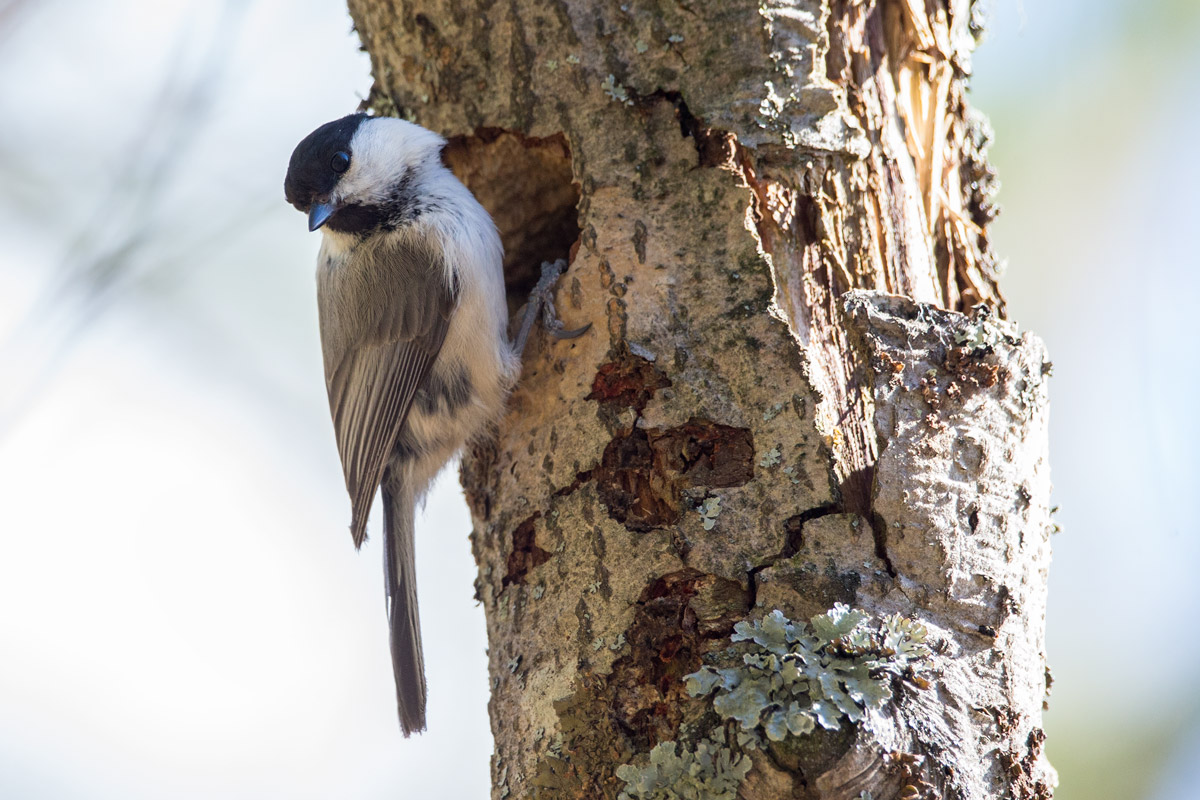
Willow Tit - Poecile montanus borealis
I found a Willow Tits nest on the campsite but the light was poor and the photo results disappointing I wanted some decent shots to show how grey they are compared to British birds and as a comparison with Siberian Tit - when I finally found one.
The following morning was clear again and the temperature rose to a very pleasant 24C. I drove back down to Kuusumo to stock up on food and have a look around lake Toranki, there was still ice on the Kuusumo end but the southern end was clear and held a nice flock of 50 Goosander and my first pair of Velvet Scoter of the trip. As I was trying to photograph a pair of Black-throated Diver a Beaver swam past just metres from me but as soon as he saw me he dived not to be seen again.
Velvet Scott - male
I checked the bushes looking for Rustic or Little Bunting but without success but came across a nice Whooper Swan sat on its nest.
Back at the feeders to Bluetail was still in song, a couple of young Finnish birders thought that had had as many as 5 in the area.